
28 Jul How to Choose the Right PLC for Industrial Automation
How to Choose the Right PLC for Industrial Automation:
1. Choose an Industrial PLC Controller Based on Your Application Requirements
First and foremost, it is essential to know your requirements before purchasing an industrial PLC controller. Every industrial automation system has its own specifications, and therefore, a PLC is to be selected depending on the complexity of the machine, production rate, working conditions, precision of control, and plans for future expansions. In some cases, like a conveyor belt or bottle filler, a small-sized PLC having input and output modules integrated within it will suffice, but in other situations like assembly line of automobiles, robot-controlled work station or pharmaceutical line, a modular and high-speed PLC having multiple I/O modules is required.
While assessing an industrial PLC controller, one needs to take into account such aspects as the amount of inputs/outputs in terms of both digital and analog, fast counter functionality, encoder feedback capability, PID temperature controller capability, data acquisition and logging, recipe handling, alarm handling, and HMI/SCADA interfacing capabilities. Other factors related to the environment that the PLC will be used in need to be considered as well. Industrial PLCs are made for operating in the industrial environment without failure, thus providing uninterrupted work with minimum maintenance efforts. Proper PLC choice according to your application needs provides increased productivity, decreased downtime and maintenance costs, etc.
2. Select the Right PLC for Motion Control Applications
In case your machinery requires accurate positioning, coordinated movements, or even servo motors, selecting a PLC dedicated to motion control is a necessity. This is because unlike the typical PLC which mostly handles sequencing, a motion PLC is built to accomplish positioning and coordination at extremely high speeds and with incredible accuracy. Applications such as automotive, electronic, semiconductor manufacturing, packaging, printing, textiles, and material handling industries depend much on motion control PLCs.
Motion Control in PLC involves performing sophisticated tasks such as point to point positioning, speed matching, electronic gearing, electronic camming, linear interpolation, circular interpolation, spiral interpolation, flying shear, registration control, and coordinated axis motion. These functionalities increase the accuracy of machines, minimizing mechanical wear and tear, as well as improving cycle times. Moreover, the use of motion PLCs increases simplicity in system design as it integrates machine sequencing and motion control in one unit. Regardless of whether there is a single axis or coordinated axis motion involved, choosing the right motion PLC will ensure that the machine works efficiently and accurately.
3. Choose a Multi-Axis PLC Controller for Complex Machine Automation
A typical modern manufacturing machine may need more than one servo motor to function concurrently in perfect synchronization. Here, the multi-axis PLC controller proves to be the best option through centralized control of different movement axes using just one CPU. It ensures that no separate controller is needed for the various axes, which makes wiring easier, makes the programming simpler, and enhances machine coordination.
Multi-axis PLC controllers are commonly applied in robotic assembly lines, CNC machines, automatic testing equipment, pick and place machines, palletizers, packaging machines, printing machines, gantry robots, and material handling machines. They facilitate synchronous positioning, camming, gearing, interpolation, coordination of movements, and operation of many servo drives at once. There are some sophisticated motion PLC controllers that can control over one hundred servo axes at once.
Through the utilization of the multi-axis PLC controller, companies have been able to realize increased production output, micron-positioning accuracy, reduced machine cycle time, and the ability to expand their systems easily in the future. The centralized motion control method is preferred because of its easy diagnostics, machine reliability, and lower cost of maintenance.
4. Select a Motion PLC with EtherCAT for High-Speed Industrial Communication
Performance of communication is one of the most important considerations when choosing a Motion PLC. In today’s manufacturing systems, there should be real-time communication among PLCs, servo drives, HMIs, remote I/O devices, vision systems, robots, sensors, and other intelligent components. It is always better to select a PLC that uses EtherCAT technology since it offers very fast communication with minimum latency, which is perfect for multi-axis motion control.
EtherCAT is one of the world’s fastest industrial Ethernet protocols, and it guarantees deterministic communication among all automation components. A Motion PLC with EtherCAT technology is capable of executing different motion profiles including electronic gearing, electronic camming, synchronizing positioning, linear interpolation, circular interpolation, helical interpolation, and robot coordination on all axes.
In addition to EtherCAT, other communication protocols supported by most advanced Motion PLCs include Ethernet/IP, Modbus TCP/IP, Modbus RTU, OPC UA, and MQTT, thereby ensuring that they integrate smoothly with SCADA systems, MES, ERP software, cloud computing and industry 4.0 applications. With high speed of communication, it is possible for manufacturers to track machine performance, gather data, carry out predictive maintenance and increase their OEE. A purchase of a PLC featuring EtherCAT not only improves the performance of machines but also makes your manufacturing plant ready for the smart factory concept in future.
5. Why Panasonic PLC is an Excellent Choice for Industrial Automation
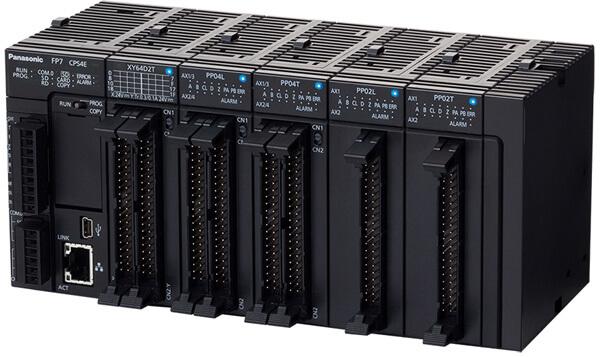
Plc solutions from Panasonic have gained a reputation of high speed operation, reliability, flexibility, and high level of motion control across various industries. When automating one machine or the entire line of production, Panasonic provides the scalable PLC platform, which includes integration of sequence control, communication, and motion control functions into one unit.
Panasonic PLC products provide fast instruction execution, scalable digital and analog I/Os, advanced PID temperature control, fast counters, pulses outputs, positioning control, and various servo applications. The Motion PLC products from Panasonic have CPUs for sequence control and motion control and thus allow executing any complex automation tasks without loss of processing speed. Panasonic PLCs are fully compliant with IEC 61131-3 programming standard and support Ladder Diagram (LD), Function Block Diagram (FBD), Structured Text (ST), and Sequential Function Chart (SFC).
Another strength is that of communication flexibility. Panasonic PLCs use technologies such as EtherCAT, Ethernet/IP, Modbus TCP/IP, Modbus RTU, RS-232, and RS-485 to communicate with servo drives, HMIs, VFDs, SCADA systems, robots, machine vision systems, barcode readers, and MES. Due to their small size, reliability, minimal maintenance needs, and longevity, these PLCs are ideal for use in devices like packaging machines, bottle filling machines, CNC machines, assembly systems, material handling machines, textile machinery, food processing machinery, pharmaceutical machinery, and Special Purpose Machinery (SPMs).
Strategi Automation Solutions offers a full range of solutions of PLC controllers that can be customized based on customer needs. The company offers services such as PLC controller selection, PLC system designing, electrical control panels manufacturing, Panasonic PLC programming, motion control PLC controller, multi axis PLC controller, motion PLC controller, PLC with EtherCAT network, HMI & SCADA development, implementation, commissioning, operator training, and post-sale technical support. Strategi Automation Solutions highly skilled automation engineers collaborate with the clients to design scalable, dependable, and future ready automation systems, which result in higher productivity and manufacturing process improvement. If you require anything from a machine controller to a full motion automation system, Strategi Automation Solutions provides you complete PLC solutions.