
18 Aug Benefits of Industrial Automation for Manufacturing Companies
Benefits of Industrial Automation for Manufacturing Companies:
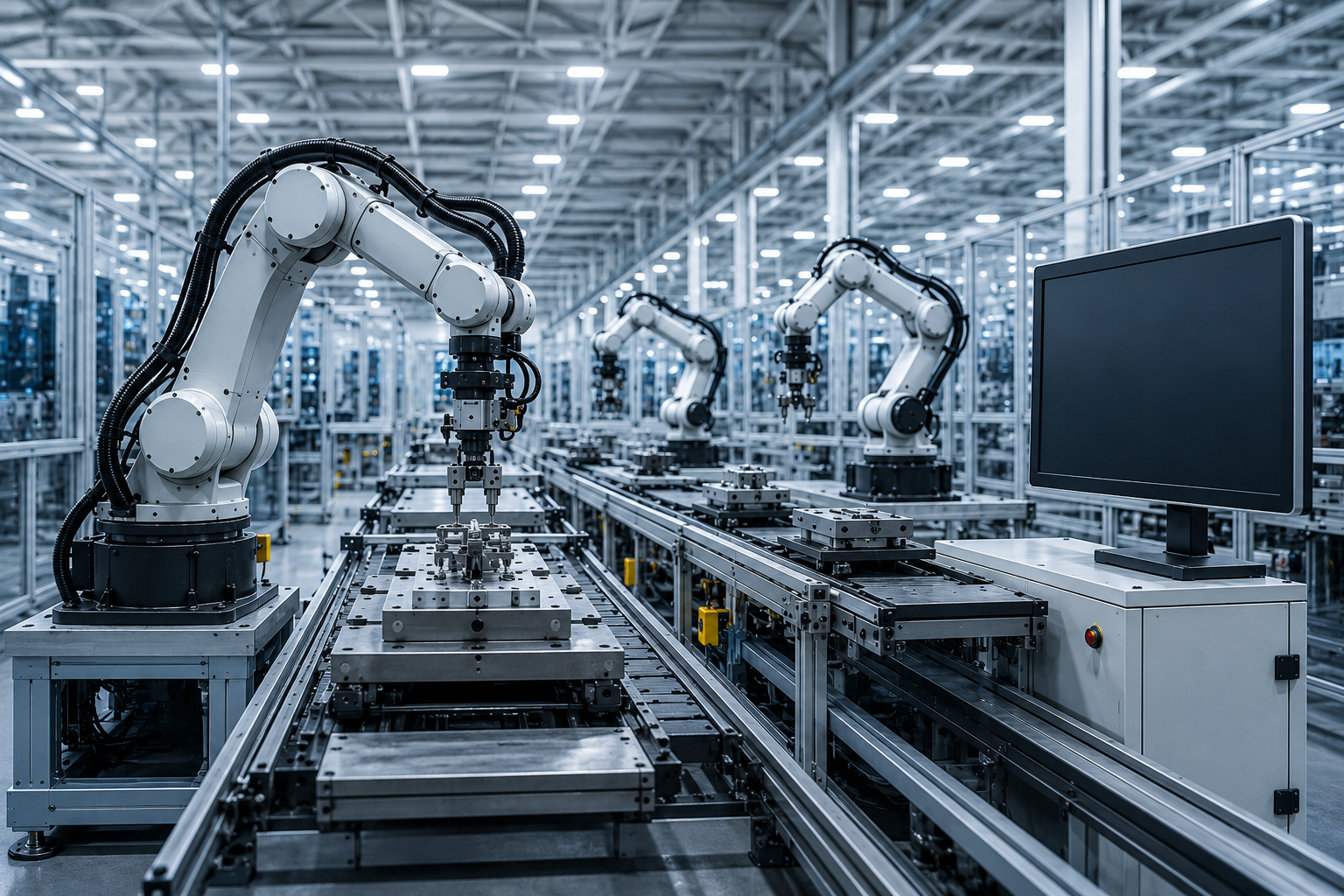
The field of manufacturing is evolving at a rapid pace. The customers demand improved quality, quick deliveries, and cost-effectiveness, while manufacturers face pressure from all sides to cut down their manufacturing expenses. This is the point where industrial automation comes into play. Industrial automation involves the use of robots, PLCs, sensors, CNC machines, servo drives, conveyor systems, and inspection systems for performing manufacturing processes.
1. Increased Production Productivity
The concept of industrial automation assists manufacturing firms in increasing their total output. This is because automated machinery and robots can carry out monotonous processes very fast. Such machinery will not get fatigued during the processes hence no reduction in performance. This helps in eliminating any possible delays within various production processes. These robots are capable of carrying out activities such as machine tending, assembling, material handling, and packaging. Industrial automation also helps the company utilize its available facilities more efficiently. The faster production cycle ensures that more orders are completed in shorter periods. This can also assist the business in meeting strict customer deadlines.
2. Improved Product Quality
Industrial automation assists in ensuring that the manufacturer can produce quality goods at all stages of production. Sometimes, manual processes lead to inconsistencies due to such factors as fatigue, experience, or even human error. Machines work according to defined procedures and parameters at each cycle of production. Robots can perform the same movement in a precise way. With the help of sensors and inspection systems, it is possible to check components and find potential faults during production. Quality checks with automation assist in decreasing defective products that would pass through to the next level. In addition, consistency of processes will decrease reworking, rejects, and wasting materials.
3. Reduced Manufacturing Costs
Industrial automation can assist manufacturing firms in reducing a number of costs associated with operation and production. Automated processes can carry out repetitive tasks with minimal manual input. This way, manufacturing firms can use their labour force in a better way to engage in tasks that require greater expertise and skill. Automation can further reduce any kind of production error, wastage of material, need for rework, and any unwanted downtime in the production process. With a more consistent production cycle, manufacturers can make use of their machinery and other resources in an efficient manner. While there will be some initial cost involved in automation, there is the possibility of making substantial gains in the long run. Increased production can also lead to the reduction in the cost of individual components.
4. Improved Workplace Safety
The manufacturing industry usually involves heavy parts, moving equipment, sharp tools, high temperatures, and physical labour. Industrial automation will allow robots and machines to execute many risky and laborious functions in manufacturing. Examples of these functions include machine tending, materials handling, welding, and palletizing, which can eliminate physical involvement in these activities. Workers are no longer forced to repeat laborious actions for their entire shift. Machines can also move in a predictable and controlled way. This might help avoid any work-related accidents and injuries. Workers will be able to concentrate on supervising, maintenance, programming, and quality control. A safe working environment might also increase employee productivity. Therefore, industrial automation ensures production efficiency as well as workplace safety.
5. Faster Production Cycles
With automation, production processes that involve repetition in manufacturing activities can be executed at a steady pace. Unlike in manual processes where operators tend to get fatigued with extended working hours, the machines and robots used in automation do not become tired when executing operations for many hours. As a result, organizations are able to maintain steady cycles within their operations. For instance, machine tending robots are able to execute operations that involve automatic loading and unloading of parts from CNC machines. The process minimizes the time needed in manual loading, unloading, and part handling. Reduced time taken in the movement of materials minimizes unnecessary wait times in between production processes. Consequently, shorter cycles enable manufacturers to increase production capacity within a certain period.
6. Reduced Human Errors
Sometimes, mistakes may arise during repetitive manufacturing procedures as a result of human actions. The mistake that may arise can include wrong loading, wrong positioning, wrong measurement, or wrong handling. Industrial automation avoids mistakes since operations will take place as per the programmed directions. Robots will always execute the same movements each time there is a production operation. Sensors can verify the presence of the parts, their positions, and any other condition of the process. Vision systems may also be installed to verify the parts and detect defects. Mistakes prevention can help the manufacturer to cut down rejection and rework costs. It can also prevent waste of materials and improve production consistency.
7. Better Machine Utilization
Manufacturing firms invest a lot in CNC machines and other types of production machinery. Utilization of such machinery to the full extent is key in ensuring the realization of optimal returns on the investments made. In some cases, manual loading and off-loading of machines may lead to the idle time of machines between the production cycles. Machine tending machines have the capacity of constantly loading the raw materials into the machines and taking off the finished products from the machines. This ensures that machine idle time is minimized. The robot can help ensure consistency in the flow of materials through the various production processes. Increased machine utilization will lead to increased production capacity without necessarily having to invest in more machinery.
8. Greater Manufacturing Flexibility
Modern manufacturers sometimes have to manufacture different types of components and different variations of their products based on changing demands from customers. Industrial automation can ensure such flexibility by means of programmable control of robotic systems. Robotic systems may be programmed in a way that will enable them to execute different kinds of movements and production operations. Different component sizes and shapes may be handled by using flexible grippers and fixtures. This means that automation is a solution for the manufacturers who have to adjust their production requirements frequently. Changes in programs can be made easily when a company needs to start producing new products or when production operations change. Automated systems can also be combined with CNC machines, conveyors, inspection machines, and other devices.
9. Better Production Monitoring and Data Collection
With today’s industrial automation solutions, manufacturers get improved insights regarding their manufacturing operations. The systems of automation can gather data via PLCs, HMIs, sensors, machinery, and other linked systems. The manufacturers can track the quantities manufactured, cycles’ duration, machine’s status, downtime, and other relevant metrics. Such information enables the manufacturers production teams to see how effectively their operations work. Through real-time tracking, it is possible to detect the production bottlenecks and machinery issues faster. The collected information can also be used for preventive maintenance and reduction of unexpected downtime of the machinery. With the production information, the managers can make better operational decisions. Data-based manufacturing also enhances the process of traceability and creation of records of the manufacturing operations.
10. Improved Return on Investment
The proper implementation of industrial automation solutions can lead to a high level of long-term benefit. More output may be obtained from manufacturing equipment that will increase value creation for the business. Improved quality may decrease costs related to the rejection of parts, reprocessing, and consumer dissatisfaction. Lower downtimes and better machine utilization may also improve production efficiency. Automation may lower the amount of repetitive tasks, which will allow workers to concentrate on skilled labour. This way, costs will be decreased, while productivity will be increased. Return on investment will depend on different factors such as volume of production, cycle time, machine utilization, and process requirements. A good automation solution may operate effectively for many years, providing its benefits. It may become a basis for further manufacturing process improvement. For this reason, industrial automation may be considered a good investment for manufacturing businesses.
Conclusion
Industrial automation is fast becoming a significant aspect of modern manufacturing processes. Automation can enable manufacturers to achieve greater productivity and consistency in their manufacturing operations through such activities as CNC machine tending, robotic material handling, inspection and production monitoring. Nevertheless, each manufacturing process is unique, and the most appropriate automation system for any manufacturing operation will depend on various factors including the volume of production, component characteristics, cycle time, machine setup, required quality standards, and projected manufacturing plans. Investing in industrial automation solutions is a strategic decision for firms that want to maintain their production levels and quality of manufacture.