
02 Jun Automated Welding Systems for High-Precision Manufacturing
Automated Welding Systems for High-Precision Manufacturing:
Welding Automation Solutions for High-Precision Manufacturing
The modern manufacturing industry is experiencing immense pressure to ensure high productivity, quality maintenance, cost reduction, and stringent customer expectations. The traditional welding techniques, though effective in certain applications, have their shortcomings when applied in high volume production processes where precision and efficiency become mandatory. The variations that may occur because of the level of expertise of the operator, speed of operation, and lack of process control among others contribute significantly to these challenges.
In response to such issues, most companies are adopting state-of-the-art technologies in the area of welding automation which incorporates process control systems, robotics, computer vision, and other forms of process monitoring mechanisms. Apart from improving the quality of welding joints and production process efficiency, these processes ensure traceability in the processes as per modern manufacturing trends. Welding automation processes play a key role in assembling components ranging from automotive parts, aviation components, electrical vehicles, and industrial components.
Automated Welding Systems That Increase Productivity and Consistency
Contemporary automation technology has been designed to facilitate streamlined operation procedures by ensuring consistent weld quality at all production stages. Automated welding technology does not rely on the expertise of the operator but instead follows a predetermined program sequence. First, the operator introduces the component into a dedicated fixture before starting the cycle. After this point, the automation technology proceeds with the entire production procedure without further need for human involvement. Some of these activities may include DMC code scanning for component recognition, child part verification via vision systems, fixture validation, welding operation, and automatic logging of the production data.
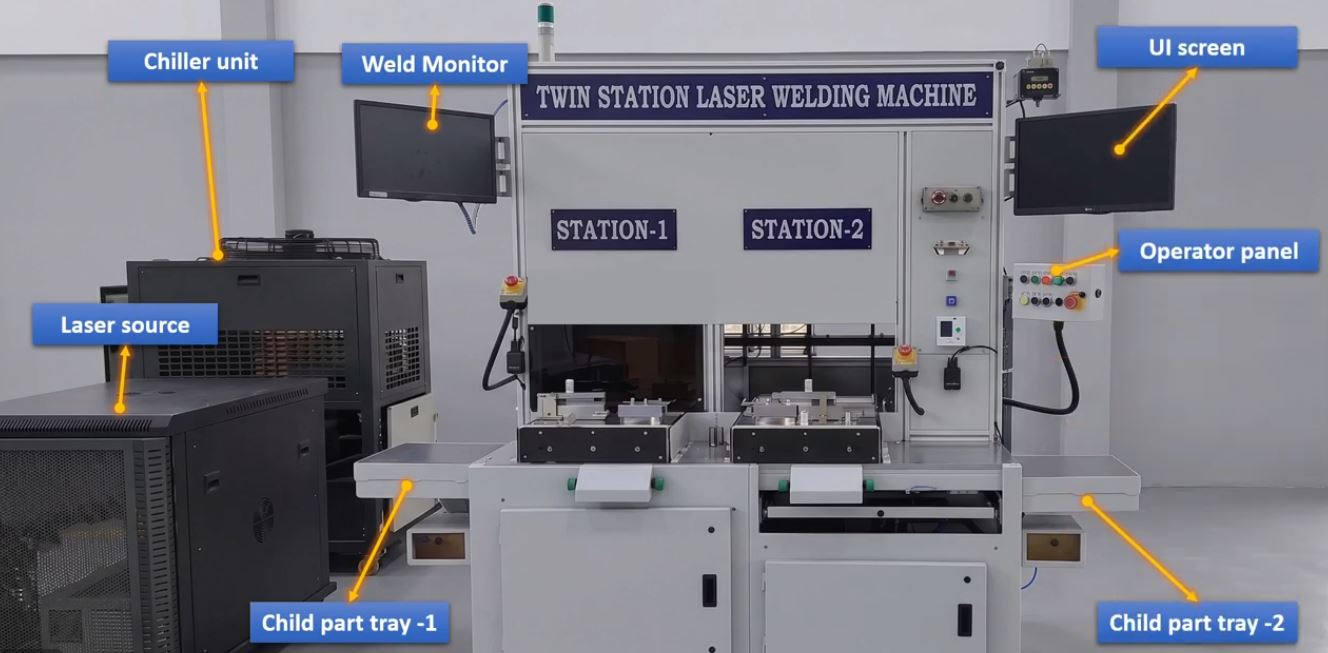
Automated welding technology helps to minimize processing time while avoiding some of the common process deviations associated with manual operations. As such, automated systems are responsible for increased production quality, increased production capacity, and lowered production costs. Twin stations are among the most preferred configurations because they ensure maximum machine use by dedicating one station for welding activity while the other station is being used for loading or unloading components. Also, the automatic system can help facilitate rapid product changeovers and the ability for various fixture types to be processed by one single machine. This helps the manufacturing process cope swiftly with changes while still maintaining quality and efficiency.
Robotic Welding Solutions Deliver Superior Accuracy and Repeatability
As the need for more effective manufacturing processes increases, more companies have started using robots for welding operations. Robotic equipment is designed to weld complex weld lines in an accurate manner and can be used where high tolerances are required. Robotic welding’s primary advantage is that the machine produces duplicate weld joints over thousands of production cycles. The robot follows the exact same pattern each time; this means that it is consistent when it comes to the quality of the weld joints formed.
The other benefit of using robotic welding machines comes in when dealing with complex shapes of parts. Whether it be the welding of chassis components, batteries, structures, or specific parts in the production sector, the robotic machines have the ability to move through complex trajectories while ensuring stable welding conditions. The other benefit of using robotic machines is the ability to store many welding profiles within the robot. The welders find it easy to access preset programs in the robot control panel and set up the welding condition like speeds, current, voltages, and trajectory. With such conditions, the machine will carry out the operation efficiently while saving the time spent on preparations. Different products will be made using only one machine. Furthermore, robotic machines ensure minimal dangers for operators because the operators will interact minimally with the process.
Industrial Welding Automation with Advanced Quality Assurance
But welding automation is more than just automation of the process itself. Modern manufacturing procedures should be supported by systems that will ensure there are no defects during the manufacturing process and that the production process will continue to be monitored. One of the crucial elements in today’s welding automation process is Poka-Yoke technologies that prevent mistakes made by employees. Before the start of the welding cycle, the DMC scanner will identify whether the correct part has been mounted in the machine, while cameras will check that all child components are installed correctly.
Verification technologies help avoid common errors related to incorrect installation of parts, improper assembly, and even mistakes related to fixture loading. If there are issues with the parts’ mounting, then the welding cycle will stop to signal the employee of the mistake. During the welding procedure, numerous aspects should be controlled and checked at all times. Current, voltage, power supply, wire feed rate, and flow rate of the shielding gas will be recorded.
The use of advanced welding fixtures will improve quality in the process by including a load measuring device and cooling system. This will make sure that proper positioning of the parts and stability of the fixtures is achieved under ideal working conditions. The issue of safety is equally important in industrial welding automation. There is the use of safety doors, protective shields, emergency stop circuit, and light curtains to ensure that the operators remain safe in the process.
Data-Driven Welding Automation Solutions for Complete Traceability
With the advent of the Fourth Industrial Revolution, or Industry 4.0, data has been identified as one of the key assets in the manufacturing sector. The latest innovations in the field of automated welding aim not only at automating the manufacturing processes but also collecting all necessary information about them. Each welding machine can be equipped with a high-tech machine dashboard, which runs on a high-quality software platform. This dashboard can be considered the primary interface for operating machines, managing recipes, tracking productions, and collecting data.
All this information about each welding process and product is recorded continuously in local or remote SQL databases. As a result, complete information on each manufactured part is collected, which includes part identification codes, welding parameters, names of operators, information about the time of production, and many other details. Traceability of products becomes especially important for those companies that have to comply with strict regulations.